Skip to content
Yes — you can add a fire pit to a deck in Massachusetts, and it is one of the most requested upgrades we build. In nearly every case it needs to be a gas or propane unit. A wood-burning recreational fire on an attached deck runs into a state rule that a deck physically cannot satisfy.
Here is what actually governs the project, what it costs, and where homeowners get it wrong.
Outdoor living on the North Shore of Massachusetts has changed in ways large and small over the past decade. Homeowners in Salem, Marblehead, Gloucester, and across Essex County are investing more in their outdoor spaces than ever before, and a custom deck is no longer just a platform outside the back door. It is an extension of the home — a place for cooking, entertaining, relaxing, and gathering with family through three seasons and sometimes four. A deck fire pit installation is one of the most common ways homeowners extend that season.
One question comes up more than any other: can you safely add a fire pit to a deck? The short answer is yes. The details matter enormously, though, and they vary from one project to the next. The type of fire pit, the deck material, the structural support underneath, and Massachusetts fire and building code compliance all determine whether the project is safe, legal, and built to last.
This is not a weekend DIY project. Done correctly, it adds real value to your property and genuinely extends the usable season of your outdoor space. Done incorrectly, it can damage your deck, invalidate your decking warranty, and give an insurer grounds to contest a fire claim. Our team of skilled and experienced decking contractors handles any deck and fire pit installation on the North Shore from design through final inspection.
Let’s look at what is involved in choosing the best fire pits for decks in the North Shore region, and why local, professional fire pit installation services make the difference.

Fire Pit Types and Which Ones Work on a Deck
Not every fire pit belongs on a deck. Fuel type is the single most important decision you will make on this project, and in Massachusetts it is partly made for you by the fire code.
Wood Fire Pit Installation on Decks
Open wood-burning units demand far more care during planning and installation. They throw embers, radiate heat unpredictably, and produce direct flame. Heat and flame are expected; it is the uncontrolled embers that pose the real threat, because sparks and shifting logs make contact with the decking surface.
There is also a regulatory problem that most articles on this topic miss entirely. In Massachusetts, a wood fire that is not being used for cooking is classified as open burning under 310 CMR 7.07 — which means it is permitted only between January 15 and May 1, only between 10 a.m. and 4 p.m., only with a local fire department permit, and only at least 75 feet from all dwellings. A deck attached to your house cannot be 75 feet from a dwelling. That rule, on its own, rules out the recreational wood fire pit on an attached deck. (See what Massachusetts actually requires for the full picture.)
Fire-retardant coatings for decks exist, but they are not a substitute for correct selection and installation, and they do not make wood non-combustible. If you are committed to the look and sound of a real wood fire, a ground-level patio or hardscape set well away from the house is the right home for it — not a deck.
Propane and Gas Fire Pit Installation for Decks
Gas and propane systems are by far the better choice for a deck. They produce an even, adjustable flame, they generate no embers or ash, and they can be shut off instantly. They are also available in a much wider range of designs. This is what makes gas the default for deck fire pit installation in this area.
They are not cool to the touch — a gas burner still produces serious radiant heat, and that heat is exactly what damages decking. The advantage over wood is control and the absence of flying embers, not lower temperature.
Liquid propane and natural gas are both viable in Massachusetts homes. Natural gas requires a permanent line run to the deck. Under 780 CMR 51.00 Chapter 24, fuel gas work in Massachusetts falls under 248 CMR — meaning the connection must be made by a licensed Massachusetts gas fitter under permit. It is not a handyman line item, and it is a real part of the cost.
Propane needs a specific correction here, because it is where we see the most dangerous mistakes. A cylinder belongs outdoors and upright, on a firm level base, in an open and ventilated spot — never tucked into the deck framing, hidden inside skirting, or sealed in a bench box. The Massachusetts Department of Fire Services directs homeowners to keep propane at least 10 feet from doors, windows, and dryer vents, and 20 feet from air intakes and ignition sources. 527 CMR 1.00 §10.11.6.4.2 prohibits containers from being placed inside or passing through any building, and §10.11.6.4.3 bars them from obstructing egress. A permanent gas fire feature is a different arrangement entirely: the tank or meter sits on grade and the piping is run by a licensed gas fitter, with a fire department LP-gas permit under 527 CMR 1.00 §69.1.2 where a tank is involved.
Fuel type at a glance
| Wood-burning | Propane (LP) | Natural gas | |
| Embers / ash | Yes — main hazard | None | None |
| Flame control | None | Instant on/off, adjustable | Instant on/off, adjustable |
| On an attached deck in MA | Effectively ruled out by the 75 ft open-burning rule unless used for cooking | Suitable | Suitable |
| Fuel supply | Manual | Cylinder, stored on grade in the open | Permanent line, licensed gas fitter |
| Permits | FD open-burning permit, seasonal | FD LP-gas permit above 42 lb aggregate | Gas permit under 248 CMR + building permit |
| Best home for it | Ground-level patio, away from the house | Freestanding table or built-in | Built-in feature |
Deck Material Matters: Composite, PVC, and Wooden Decks with Fire Pits
Your decking material directly changes how the installation has to be designed. This is where North Shore homeowners most often guess wrong — and the common assumption is backwards.
Composite and PVC Decking
High-quality composite and PVC products from Trex, TimberTech/AZEK, and Fiberon are the most popular choice for new deck construction on the North Shore. They resist moisture, sun exposure, salt air, and freeze-thaw cycling, which are all critical factors in towns like Nahant, Revere, and Gloucester.
They are also more vulnerable to heat than pressure-treated lumber, not less. Trex states that its decking can soften at temperatures as low as 176°F — well below the ignition point of wood. Sustained radiant heat makes composite melt, sag, warp, discolor, and weather prematurely. If you take one thing from this section, take that.
The manufacturers are explicit, and their warranties are stricter than most homeowners realize:
- The Trex Decking Installation Guide (p. 8) instructs that a gas fire pit “is installed by cutting around the Trex decking. It is not to be installed on top of Trex® decking.” Wood-burning units “are not recommended directly on top of Trex® decking unless using a protective thermal barrier” — and even then, “embers could shoot beyond this and burn the deck.”
- The Trex Limited Warranty expressly excludes damage from “contact with extreme heat sources (over 275°F/135°C).”
- The TimberTech AdvancedPVC Limited Warranty names “fire, hot ashes/embers, fire pits” among excluded causes of distortion, damage, and fading.
- Fiberon states that “improperly installed fire features and fire pits can cause damage to the surface of Fiberon decking via direct exposure to the flame or excessive radiated heat.”
Note what this means in practice. A heat-resistant pad laid on top of the boards is not the standard — Trex’s own instructions call for cutting the decking away around a built-in unit so the feature bears on its own non-combustible base rather than on the deck surface. We build to the stricter of the two: the appliance manufacturer’s listing and the decking manufacturer’s installation guide.

Pressure-Treated Wooden Decks with Fire Pits
Wooden decks with fire pits need their own level of attention. Pressure-treated lumber is the most common option for a wood deck — it resists rot and insect damage — but it remains combustible, and treatment does nothing to change that. On a wood deck, a gas fire pit installation should sit on a non-combustible pad or platform, with deliberate spacing from railings, skirting, furniture, and anything overhead.
On an older deck already showing wear, the deck’s overall condition has to be evaluated before any fire feature goes on it. A fire pit installation on a structurally compromised deck is not a project we will take on. That is why every job starts with an inspection, so we can design and install a feature that is safe for your home and family — and why deck repair is sometimes the honest first step instead.

Structural and Footing Requirements for a Built-In Deck Fire Pit
Every deck fire pit installation we design starts with the load path, because a built-in feature adds substantial concentrated weight. Stone or concrete surrounds, burner components, gas lines, and decorative finishes add up faster than homeowners expect, and that load lands on a small footprint rather than spreading across the deck. The framing has to carry it without excessive deflection or movement.
On a new deck, that is designed in from the start. On an existing deck, it has to be evaluated — additional joists, doubled beams, a dedicated post and footing under the feature, or blocking may all be needed. This is the part of the job that is invisible when it’s done right and impossible to retrofit cheaply when it’s skipped.
Footings matter just as much, particularly in this climate. They have to be sized and set for local frost depth and soil conditions, or freeze-thaw movement will eventually crack a stone surround or pull a gas line out of alignment. Coastal properties in Marblehead and Essex often have different soil than inland lots a few miles away, and salt exposure changes hardware and fastener selection. Site evaluation and local experience are not optional on a deck and fire pit installation on the North Shore.
What Massachusetts Actually Requires: Permits, Clearances, and the Cooking Distinction
This is the section most articles get wrong, so it is worth being precise. Massachusetts does not adopt the International Fire Code. If you have read that a fire pit must be 15 feet from a structure “except at one- and two-family dwellings,” that is IFC §307.4.3 — the wrong state’s code. Massachusetts fire safety runs on 527 CMR 1.00, which is NFPA-1-based, and the Massachusetts amendments delete the section where that distance table lives.
Here is what does apply.
Cooking versus recreational fires — the distinction that decides the project
Massachusetts treats these as two different things, and the difference is decisive on a deck:
- Outdoor cooking is allowed year-round in every community and is not subject to open burning limits. The fire has to be kept to a reasonable size, contained in a non-flammable enclosure, and tended by someone 18 or older.
- A wood fire that is not for cooking is open burning. Under 310 CMR 7.07 that means a permit from the local fire department, a season limited to January 15 through May 1, hours limited to 10 a.m. to 4 p.m., and a minimum of 75 feet from all dwellings.
No attached deck meets 75 feet. That is the practical reason a gas feature is the recommendation here, and it is a much better reason than “embers are dangerous.”
Clearances you can actually cite
- 10 feet from a building. 527 CMR 1.00 §10.11.6.3.6 provides that cooking and heating appliances shall not be used or stored under any overhang, or less than 10 feet from a building, unless the space is sprinklered or the manufacturer’s instructions and equipment listing permit it.
- 75 feet from all dwellings for open burning, per 310 CMR 7.07. A Department of Fire Services advisory confirms that where the fire and building codes conflict, the DEP standard prevails because it is the higher standard of safety.
- The manufacturer’s listed clearances govern. 527 CMR 1.00 §10.11.6 requires appliances to be used in accordance with the manufacturer’s instructions. On a deck this is usually the binding number.
- Roofed and enclosed spaces are out. DFS guidance is that appliances cannot be used on a porch, balcony, or deck with a roof, overhang, or wall other than the exterior of the building; they are permitted on open first-floor porches, decks, or patios with an outdoor stairway to the ground.
Permits you will likely need
- Building permit. Under 780 CMR 51.00 R105.2, the exempt-work list does not include fireplaces, fire pits, or gas piping, and decks are exempt only if under 200 sq ft, under 30 inches above grade, and unattached. In practice, an attached deck and any structural modification for a fire feature both require a permit. The 10th edition of the code has been the sole authority since July 1, 2025.
- Gas permit and licensed gas fitter under 248 CMR for any natural gas or permanent propane connection.
- Fire department LP-gas permit under 527 CMR 1.00 §69.1.2 for propane storage, use, and handling, and for stationary installations. Per Table 1.12.8.50, aggregate quantities under 42 lb (10 gallons) need no permit; from 42 lb to 2,000 gallons a permit is required. The installer must file a certificate with the head of the fire department within 72 hours.
- Open burning permit under 310 CMR 7.07 if a wood fire is involved at all.
Local rules sit on top of all of it
Mass.gov states plainly that “some cities and towns regulate, limit or prohibit the use of chimineas, fire pits and outdoor fireplaces.” Twenty-two Massachusetts communities ban open burning outright — Lawrence, in Essex County, is one of them — so do not assume the North Shore is uniformly permissive. Salem, Gloucester, and Lynn all enforce the Massachusetts State Building Code alongside their own local requirements, and each runs its own permit process.
Working with a contractor who handles deck fire pit installation in the North Shore area regularly is how this gets planned, permitted, inspected, and built to standard the first time.

Deck Fire Pit Ideas for North Shore Homes
A well-designed feature becomes the focal point of the deck and makes the space genuinely comfortable on cool North Shore evenings. The right approach depends on the deck’s size, how the space gets used, and whether you want something permanent or something you can move.
Built-in ideas for larger decks
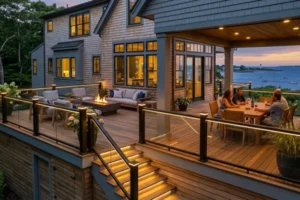
Larger decks give you room for a custom built-in. The feature can be integrated into a seating wall, a defined gathering area, or a broader outdoor room — and it pairs naturally with deck lighting and a pergola for shade. Bluestone, granite, and fieldstone are the materials that read as authentically local here, and they hold up to the weather. These are the fire pit design ideas for Massachusetts homes that tend to age best.
A small deck with a fire pit
A small deck with a fire pit works when the layout is planned around it. A compact gas table gives you flexibility without committing floor area permanently, and a modest built-in can be tucked into one end with seating arranged around it. The constraint to respect is clearance — to the house, the railings, and anything overhead — while preserving comfortable movement through the space. Our backyard deck ideas post covers more layout options for tighter footprints.
| Deck size | Fire pit options | Design approach | Best for |
| Large | Built-in gas feature, custom fire table | Integrate with seating walls or a defined outdoor room | Entertaining and larger gatherings |
| Medium | Compact built-in or gas fire table | Create a gathering area without dominating the deck | Family use and casual entertaining |
| Small | Compact gas table or small built-in | Keep the feature to one side; preserve open walking space | Smaller yards and tighter footprints |
What a Deck Fire Pit Costs on the North Shore
Homeowners reasonably want a number before they commit. Deck fire pit installation ranges widely in price because the variables are significant, so here is what actually drives it.
What the published averages say
A freestanding gas table on an existing deck, fed by a propane cylinder stored on grade, is the most affordable route. A fully custom built-in with a natural stone surround, an integrated seating wall, a permanent gas line, and framing modifications is a different scale of project entirely. Published national cost data brackets both:
| Configuration | Published range | Source |
| Portable or prefab unit, no installation | $75 – $500 | HomeGuide, Feb 2026 |
| Propane fire pit, professionally installed | $300 – $950 | Angi, Aug 2026 |
| Propane fire pit, professionally installed | $900 – $2,000 | HomeGuide, Feb 2026 |
| Natural gas fire pit, installed | $400 – $3,000 | Angi, Aug 2026 |
| Natural gas fire pit, installed | $3,500 – $8,000 | HomeGuide, Feb 2026 |
| Custom in-ground build | $1,000 – $5,000 | Angi, Aug 2026 |
| Custom stone fire feature | $6,000 – $20,000 | HomeGuide, Jan 2026 |
| Gas line run | $15 – $50 per linear foot | Angi / HomeGuide, 2026 |
| Permit fees | $20 – $500 | Angi, Aug 2026 |
Two caveats matter more than the numbers themselves. These are national averages, and greater Boston runs above the national mean on skilled trades. More importantly, almost all of these figures describe a fire pit set on a patio or in the ground — not on a deck. A deck installation carries costs the national data does not capture, so plan on the upper end of the published ranges rather than the middle.
What actually moves the number on a North Shore deck
The biggest swing factors, in rough order of impact:
- Structural reinforcement. Whether the existing framing can carry a concentrated load, or needs added joists, beams, and footings.
- The gas connection. Massachusetts requires a licensed gas fitter under 248 CMR. Distance from the meter and the routing path drive this line item.
- Stone selection and seating wall length. Granite and bluestone are not priced alike, and linear feet of wall add up fast.
- Permit fees and inspections, which vary by municipality.
- Site access and coastal conditions — hardware upgrades for salt exposure, and footing depth.
Because those five variables swing so widely from one property to the next, the only number that means anything for your deck is the one that comes after someone has looked at your framing. We quote in writing, with the scope itemized.
Cost figures cited above reflect published national averages as of August 2026 and are not quotes.
The case for a professional installation
The return here is real, though it shows up in two different ways.
At resale, a permitted, professionally built outdoor space with a defined fire feature is a differentiator in a competitive market — it reads as finished rather than added-on, and the paperwork trail matters to a buyer’s inspector.
The more immediate return is how you use the property. A fire feature turns cool spring and fall evenings into usable ones, which is most of the reason our clients ask for them. Having a comfortable, safe place to sit outside is what gets a deck used rather than looked at.
There is also a downside worth stating plainly. An improperly installed fire feature will not cancel your homeowners policy — but it can give an insurer grounds to contest a fire claim. The Massachusetts standard fire policy provides that the insurer is not liable for a loss occurring “while the hazard is increased by any means within the control or knowledge of the insured” (M.G.L. c. 175 §99). Unpermitted, uninspected work also creates personal liability exposure if a guest is injured, and it tends to resurface at resale. Keep the permits, the gas fitter’s certificate, and the inspection sign-off — and tell your agent what you added.

Get Professional Fire Pit Installation Services Today
A deck fire pit installation adds warmth, function, and usable outdoor space to a North Shore home — when it is planned correctly. Choosing the right fuel, accounting for structural loads and clearances, meeting Massachusetts code, and selecting materials suited to this climate are all part of getting it right.
At North Shore Deck Builders we design and build custom decks and outdoor living spaces across the region. Whether you are in Salem, Lynn, Revere, Marblehead, Gloucester, Peabody, Nahant, Essex, or the surrounding communities, we can help you evaluate the options and plan the project properly from the start — whether you are adding to an existing deck or planning a new deck and fire pit installation on the North Shore.
Ready to talk it through? Contact North Shore Deck Builders for a free project estimate. Our local deck contractors in Massachusetts will help you find the option that fits your home, your property, and how you actually want to use the space.

Frequently Asked Questions
What type of fire pit is best for a deck?
Gas and propane units are the best choice for a deck. They deliver a controlled, adjustable flame with no embers, sparks, or ash, and they shut off instantly — the failure modes of a wood fire simply are not present. In Massachusetts there is a second reason: a wood fire that is not used for cooking counts as open burning under 310 CMR 7.07, which requires it to be 75 feet from all dwellings. An attached deck cannot meet that. Gas models come as freestanding tables or built-in features; the right one depends on your deck layout, fuel access, available space, and design.
Do I need a permit to install a fire pit on my deck in Massachusetts?
Usually more than one. A built-in feature typically needs a building permit — 780 CMR 51.00 R105.2 does not exempt fire pits or gas piping. Any gas connection requires a permit and a licensed gas fitter under 248 CMR. Propane storage and stationary installations require a fire department LP-gas permit under 527 CMR 1.00 §69.1.2, with no permit needed below 42 lb (10 gallons) aggregate. A wood fire additionally requires an open burning permit under 310 CMR 7.07. Local rules layer on top: mass.gov notes that some cities and towns regulate, limit, or prohibit fire pits outright.
How much space should I leave around a deck fire pit?
Three numbers matter. Cooking and heating appliances cannot be used or stored under an overhang or less than 10 feet from a building unless the space is sprinklered or the manufacturer’s listing allows closer placement (527 CMR 1.00 §10.11.6.3.6). Open burning must be at least 75 feet from all dwellings (310 CMR 7.07). And the manufacturer’s listed clearances for your specific appliance govern, which on a deck is usually the binding constraint. Clearances apply to the house, siding, windows, railings, and anything overhead, and they belong in the design rather than being discovered at inspection.
Can you fireproof a wooden deck?
No. A wooden deck cannot be made fireproof. Fire-retardant treatments may slow ignition, but they do not make wood non-combustible, and no coating changes how a code official or an insurer views the installation. The workable approach is a properly designed gas or propane feature, correct clearances, non-combustible materials beneath and around the unit, and any structural issues resolved first.
What is the best fire pit for a composite deck?
A properly installed gas unit. But composite is more heat-sensitive than most homeowners assume — Trex reports that its decking can soften at temperatures as low as 176°F, and Trex, TimberTech/AZEK, and Fiberon all exclude heat and fire damage from their warranties. Trex’s installation guide goes further and directs that a gas fire pit be installed by cutting around the decking rather than sitting on top of it. Follow both the appliance listing and the decking manufacturer’s guide, and build to whichever is stricter.
What is the safest way to install a built-in fire pit on a composite deck?
Use a properly rated gas or propane feature, and treat the decking manufacturer’s instructions as binding. In Trex’s case that means cutting the boards away so the unit bears on its own non-combustible base — not laying a pad over the deck surface. Surrounding materials should be non-combustible, the framing must carry the concentrated load, and the gas connection must be made by a licensed Massachusetts gas fitter.
Can I add a fire pit to an existing deck?
Often, yes — but the structure has to be evaluated first. A built-in adds significant concentrated weight on a small footprint, which is different from the distributed load a deck is designed for. Depending on framing, span, and condition, additional joists, beams, blocking, or a dedicated footing may be required. On a deck already showing rot, movement, or failing connections, repair comes first.
Can a fire pit damage a deck?
Yes, and it is the most common avoidable outcome. Excessive radiant heat, insufficient clearance, concentrated load on undersized framing, or an installation that ignores the decking manufacturer’s instructions will all do it. Composite and PVC are particularly susceptible to melting, sagging, and warping, and that damage is explicitly excluded from the major manufacturers’ warranties. Accounting for heat, weight, framing, and clearances at the design stage is what protects the deck.
Can a small deck have a fire pit?
Yes, when the feature is scaled to the space and the layout preserves the required clearances. Compact gas tables are usually the practical answer on a smaller deck. A built-in can also work if it is positioned to one side so walking routes and comfortable seating survive. Clearance to the house and railings is the limiting factor, not floor area.
How much does a deck fire pit cost?
Published national averages put a professionally installed propane unit at roughly $300 to $2,000 and a natural gas unit at $400 to $8,000 depending on the source, with custom stone fire features running $6,000 to $20,000 (Angi, August 2026; HomeGuide, 2026). Gas line runs add $15 to $50 per linear foot and permit fees $20 to $500. Expect the upper end of those ranges on a deck: most published figures describe patio or in-ground installations, and a deck adds structural reinforcement and, in Massachusetts, gas work that must be performed by a licensed gas fitter under 248 CMR.
What should I consider when installing a fire pit on a backyard deck?
Fuel type, deck material, structural capacity, required clearances, gas access, ventilation, and local permit requirements — roughly in that order. Beyond code, think about how the deck is actually used: installing a fire pit on a backyard deck works best when the feature has enough space around it for seating and circulation, and when it sits where people already gather rather than where there happens to be room.
What are good fire pit design ideas for Massachusetts homes?
Built-in gas features with natural stone surrounds, compact gas tables for smaller decks, and fire features integrated into seating walls or a broader outdoor room all work well here. Bluestone, granite, and fieldstone suit North Shore architecture and handle the freeze-thaw and salt-air exposure that inland materials sometimes do not.
Should I choose a built-in or freestanding deck fire pit?
A built-in becomes a permanent focal point and can be integrated into seating, walls, and the overall deck design — it is the better long-term answer if you are building or rebuilding anyway. A freestanding table is more flexible, cheaper, movable, and storable over winter. Deck size, budget, appearance, and how long you plan to stay are what decide it.